Notice: Function _load_textdomain_just_in_time was called incorrectly. Translation loading for the nimble-builder domain was triggered too early. This is usually an indicator for some code in the plugin or theme running too early. Translations should be loaded at the init action or later. Please see Debugging in WordPress for more information. (This message was added in version 6.7.0.) in /home1/portfol1/public_html/wp/wp-includes/functions.php on line 6131

Notice: Function _load_textdomain_just_in_time was called incorrectly. Translation loading for the restrict-user-access domain was triggered too early. This is usually an indicator for some code in the plugin or theme running too early. Translations should be loaded at the init action or later. Please see Debugging in WordPress for more information. (This message was added in version 6.7.0.) in /home1/portfol1/public_html/wp/wp-includes/functions.php on line 6131

Deprecated: preg_split(): Passing null to parameter #3 ($limit) of type int is deprecated in /home1/portfol1/public_html/wp/wp-content/plugins/add-meta-tags/metadata/amt_basic.php on line 118
Portfolio Yoga - Part 65
Deprecated: Function WP_Dependencies->add_data() was called with an argument that is deprecated since version 6.9.0! IE conditional comments are ignored by all supported browsers. in /home1/portfol1/public_html/wp/wp-includes/functions.php on line 6131

Deprecated: Function WP_Dependencies->add_data() was called with an argument that is deprecated since version 6.9.0! IE conditional comments are ignored by all supported browsers. in /home1/portfol1/public_html/wp/wp-includes/functions.php on line 6131

Post Election thoughts

While Nifty did close positive, the very fact that we gained just about 100 points for a victory of the kind unseen since 1977 (non congress) does in a way reduce the enthusiasm about whether markets are really ready to take off or are we seeing a topping out formation.

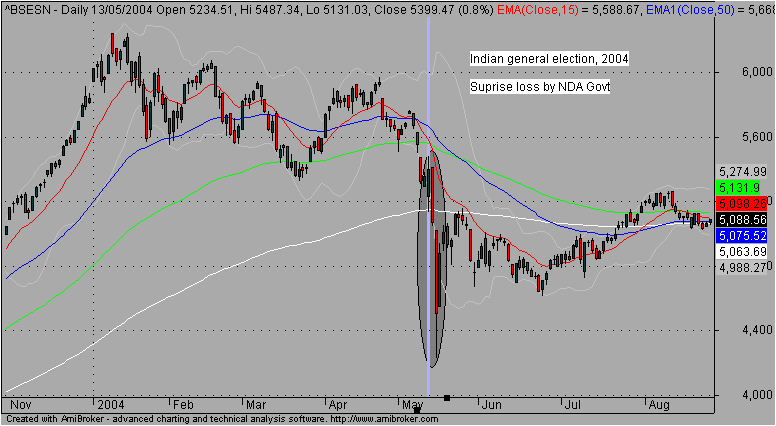
On one hand, this move of today has a precedence in the way markets behaved on the day of results of 2004. Nifty closed with a small positive despite the fact that NDA which was seen as the front runner to the next government came up short and instead it was the Congress supported by the Left parties who were staking their claim to power. What happened in the next two days is history.

With the comprehensive victory for Modi, I believe most broking houses will start upgrading their targets for Sensex / Nifty on the back of optimism generated by the slogan of Modi “minimum government maximum governance”. In fact, UBS has already confirmed its target of 8000 for Nifty.

They key question is, Shall we see a run away rally? On the basis of evidence (some of which I shall present here), I guess not. But what I am sure off is the fact that this could be a turning point in the Indian Economy. The last such turning point in my opinion was the 1991 elections where P V Narasimha Rao took over the Premiership after India’s first experiment with coalition politics had brought the economy virtually to its knees. Over the next 5 months, Sensex rallied by around 29% (in hind-sight though, this was the led by Harshad Mehta). Since the markets never re-tested levels seen in the first few months of PVN, I believe that genuine progress in between (with economy being opened up) added up to the rise in markets and all of it were not due to the scam.

Where we do differ from 1991 is in terms of how cheap or expensive the markets were at that point of time. Right now, Nifty trailing PE (Standalone) is around 19.5 while Sensex PE when PVN took charge was 15.5. But since Indian economy was closed and we were growing at a much lower pace, this additional risk is not as big as it appears to be. 

Small and Mid Cap index stocks are generally those having high beta and hence these stocks tend to ourperform the large cap indices. A look at the past data seems to suggest that markets tops have been accompanied by strong out-performance of Small Cap Index vs Nifty whereas at the current juncture, all Indices seem to be moving in tandem and there appears to be still some way to go before a major top is made.

Chart 1 – RS comparison of CNX Small Cap, CNX Mid Cap and CNX Nifty

Period: Jan 04 – Dec 07

Image

Chart 2 – RS Comparison of the same indices for period Oct 2008 to November 2010

Image 

  Chart 3 – the current stage. Time period starting from Jan 2012

Image


In the second pane of the chart below, I have plotted the Net New Highs in NSE. This is a way to gauge the breadth of the market since if markets are moving higher with very few stocks making new yearly highs, its just a matter of time before such move collapses. 

I have marked in a box the period from the election results of 2009 to the top we saw in late 2010. One can see the consistent nature of the new highs. On a similar nature, I believe that we are just seeing the start of a run up as its just recently that the Net New Highs has broken into positive territory.

Image

In recent times, whenever India has seen a strong government at the center, markets in the next one year have given pretty good positive returns. The only times when this did not happen was in 1999 when NDA formed the government. The hitch if one were to say is the fact that we have been strongly out-performing the world markets (majority of them) in a big way even before the ink on the fingers (elections) were set. 

During the last days, we saw the release of CPI for the month of April which came in at 8.59% and March IIP data which once again was in negative territory 0.5%. With Diesel prices being raised by 1.09 right after the elections got over, Inflation numbers over the coming months will not be easy to vanquish. This is seen by the strong yields  in Government Bonds which despite the euphoria closed yesterday at 8.83%. 

Below is a Nifty chart with the lower panel showing the number of days since the 200 MA was breached. As can be seen, we are nowhere close to new highs but at the same time, we are coming in close to the highs reached after the market topped out in 2010.

Image

Another way to look at the above data would be to measure the % difference between the current price and 200 MA and the same is plotted in the chart below

Image

Once again we can see that this rally is nowhere comparable to the ones we had seen earlier before markets topped out for the medium to long term despite Nifty trading at its all time highs.

Even in a bull market, markets do not go up in one straight action but is pretty choppy on the extreme short term. As can be seen in the chart below, Number of occasions when Nifty suffered a loss of 5% of more during the bull phase of 2003 – 2008 is much higher than the ones we have seen since 2010. In fact, we have seen more instances of 5% up over 2 days than 5% down over 2 days, but as the market evolves, look forward to more of them.

Image

The Narendra Modi government that comes to power is coming with the highest expectation one has ever seen (since 1977 I assume) and that in itself can turn out to be a negative for markets since its not easy for even a guy who has showcased the development of Gujarat to turn around the story overnight. 

At the same time, I believe that the next couple of years provide one the best opportunity to set up the foundation for what Rakesh Jhunjhunwala will call “The mother of all bull rallies”. As I sign off, here is me, hoping for the best 🙂


Betting on Elections – Gambling or Trading

On Twitter, its amazing to see the number of winners who seem to be right in whatever trade they report (mostly after the move) and in an attempt to get them to commit to something, commented that I was going into the election result day with “Long Nifty” positions.

Good friend, Nitin of Alpha Ideas replied back with a quote by “Paul Tudor Jones” and I quote the same here

“I don’t risk significant amounts of money in front of key reports, since that is gambling, not trading”

Now, unlike the hundreds of quotes available, this is from a guy who is seen as one of the Top Technical Analysts ever (Link) and hence something that cannot be dismissed off hand (as I generally tend to do). This guy has some serious skin in the game (as against the guy who invented that term but seems to spend more time talking than trading – but that is for later:) ).

In many ways, trading is generally seen as Gambling though the gulf between gambling and trading is as wide as the Brahmaputra at its widest point. A gambler is one who takes risk with not much of a risk management and generally in a place where the odds of winning are pretty low.

The big question out here is, If I am positioned for the election result – am I gambling or this is as normal a trade as any other I take? To answer that, let me give you the thought process that made me willing to bet (and I generally bet as much as I can afford – no half measures out here) and why I believe that if one looks at history (and TA is all about the history repeating itself), betting on the long side is the way to go.

I am a believer in positional systematic trading and believe that intra-day trading or discretionary trading (gut based or based on ideas that cannot be historically tested to see its accuracy) is not the way to go. I am also a strong believer in trend following since evidence has shown that all said and done, for some reason that is as yet not explained, trends do persist more often than they are supposed be. 

The big profits of a trend follower come from the outlier’s – moves that are 3 / 4 or even 5 standard deviation from the mean and which theoretically should not occur in decades or centuries but which happen more often that not. Its the outlier that ensures the profitability (extra Alpha if I may say) of a trend following system since it generally has more loss making trades than profit making and these one off trades more than compensate for all the losses.

Outliers can occur due to various reasons – Known events and Unknown events. Election results are a known event since regardless of what happens, results will be out by day’s end. On the other hand, a attack on the World Trade Towers in 2001 was an Unknown event since no one knew such a thing could happen.

A couple of years back, I had given a talk on Trend Following and showcased as to how markets seemed to be perfectly aligned with the post event trend even though in case of unknown events, the very event was a surprise. Let me take you through some of the examples I provided in that talk

1. Fall of BJP led NDA Govt in 2004

Image

As can be seen, in the run up to the results, despite the euphoria of “India Shining”, the markets were considerably weak. Markets closed with small gains on result day and tumbled in the next couple of days.

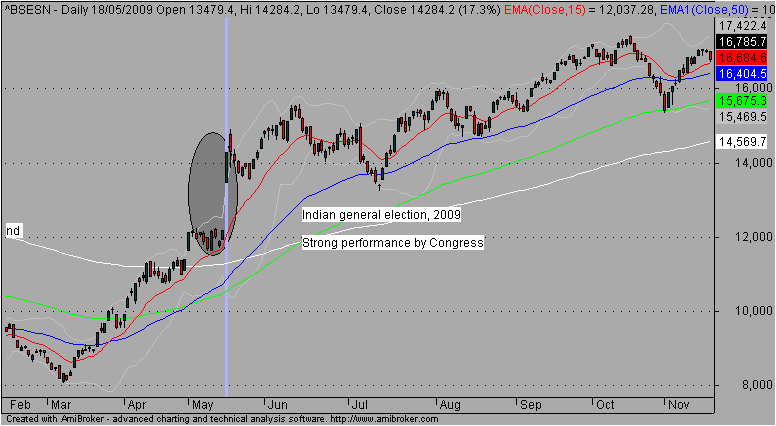
2. UPA wins the election in 2009

Image

Now, this was supposed to be so big a surprise (especially that of Congress along mopping up >200 seats) that Index froze higher. But look at the chart and say that the trend was anything other than bullish

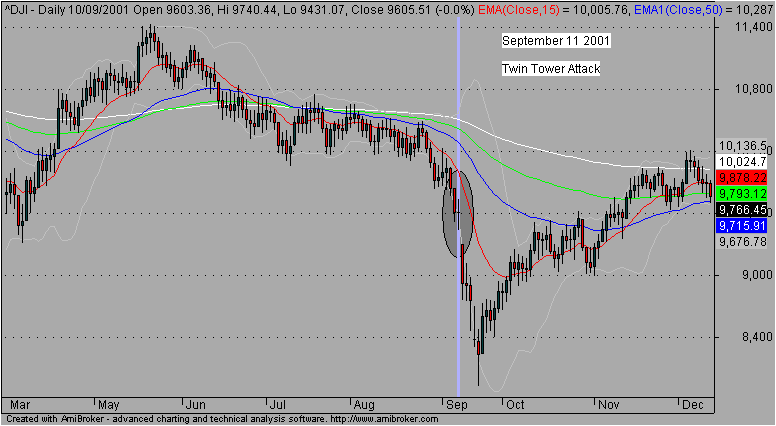
3. Terrorist Attack on World Trade Towers

Image

Now, this was a unknown unknown event of a magnitude not seen in a very long time and yet, Dow was strongly bearish before the event and the only thing that this did was accelerate the fall when markets re-opened.

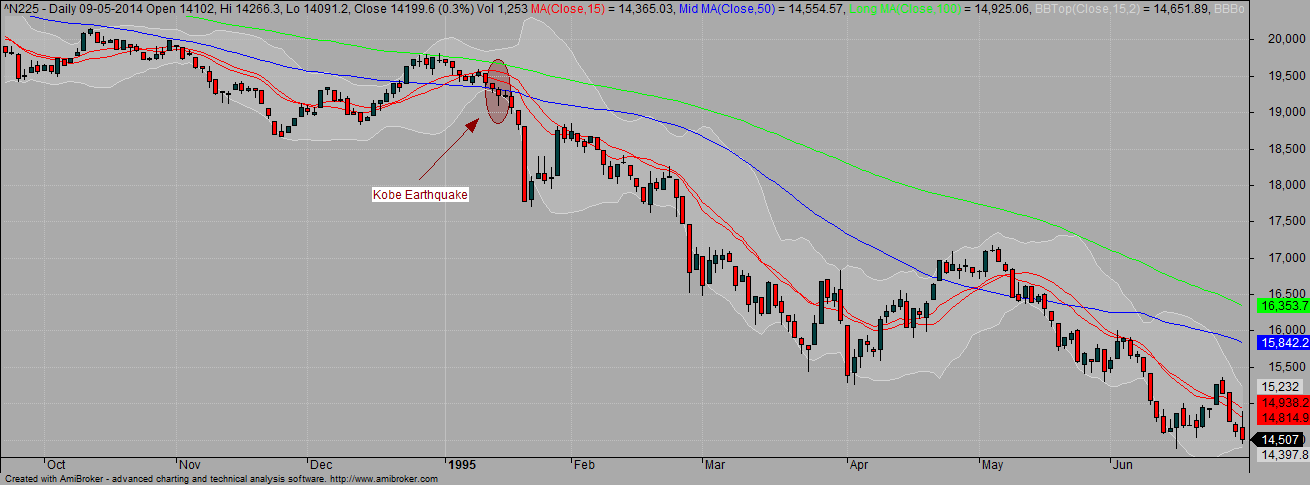
4. Great Hanshin earthquake, Kobe Earthquake

Image

Japan was rattled by the Kobe earthquake and in a in-direct way was the cause of the fall of Barings Bank (Nick Leeson). One look at the Nikkei chart above, the trend was already present and in fact, it was only 2 days after the earth quake happened that Nikkei started to crack strongly.

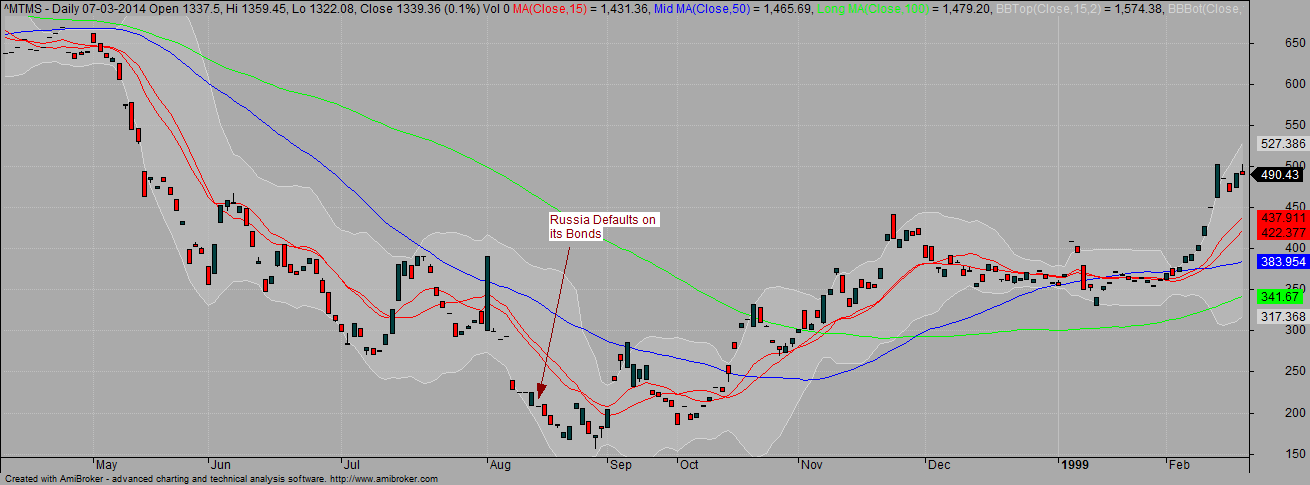
5. Russia Bond Default

Image

Russia in 1998 defaulted on its own loan and this in a way shook the world markets then. The default was the key catalyst to the end of one of the biggest hedge funds of that time – Long Term Capital Management. Look at the trend and say that the markets had no clue about it

I believe if one were to dig deep, one can find even more examples of how the markets were most of the time in line with the trend well before the event and the event in itself was not a surprise to anyone other than maybe those in the media.

My own bet on the markets today has been based on a system I trade and has been tested both historically and in real time for quite some time now. Add to it, unlike 2009, this time around, the trends and the results will be during market time and shall not be a surprise at the open.

Its easy to rationalize as to why one should not trade before key events, but as I have shown in the examples above, if you are with the trend, there is little to fear about. 


Nifty 7000

If measured in terms of time taken for Nifty to climb the 1000 points from 6000, this has been the 2nd longest since Nifty started in 1996.

Image

The first 100 point move was the start of the massive bull rally we saw in 2003 – 2007. Will this be the starting point of another bull rally? Time shall tell for sure though

What happens the day after a 3% move

What a massive move it was today in the markets with Nifty gaining more than 3%, something that was last seen in September 2013. Since we started trading Nifty futures, this is the 99th occasion wherein Nifty has closed above 3% .

Its interesting to note that of the 98 occasions, the next day has seen momentum continue only on 52 occasions (i.e., 53% of the time) while on 46 occasions, we actually saw the markets reacting.

When it comes to average gains and average losses (using Geomean), the swing turns to the negative side with average loss being to the tune of 1.98% vs average gains of 1.71%.

With statistics being divided more or less equally, I believe that the better way to approach the situation would be to continue to hold on (if one is already long) to their position and exit only on a signal they can trust (or use). 

Since we shall see the final phase of elections on Monday and the results will be declared (more or less) on Friday, coming week should continue to remain volatile with both sharp rallies and falls being equally possible.


Buying ill-liquid Stocks

Markets at near all time highs and the euphoria of a further rise in case NDA comes to power (with a massive majority to boot) has meant that retail is starting to enter in a small way. But since most of the big guns have already become too expensive (in terms of price of shares mostly though for many valuations are a stretch at the current juncture), its a season for those stocks which barely saw any trade for hours together to now be the ones much talked about.

Most of these stocks which lay theoretically dead are now roaming around like zombies though from afar, they do seem like normal behavior and hence easy to mistake one for the other.

The problem in most of these stocks is not in getting in as much as getting out. Right now, its time to get out of many such stocks as volumes have suddenly sprung up on the back of pretty good increase in price.

Warren Buffett says and I quote

“Only buy something that you’d be perfectly happy to hold if the market shut down for 10 years.”

While it makes sense logically, the problem comes in terms of practical suitability of it especially in a market where stocks go out of favor before you know. Add to that, while its true that good stocks are better held for the real long term, our life requirements mean that if for any reason we want to exit a stock, we should be able to do it without having to take massive slippage costs.

Liquidity should be the corner stone of investments in companies where you do not have a meaningful stake and one which you regard as something that could be en-cashed during times of distress. After all, what is the point in having stock worth lakhs if it cannot help you when you need it most.

The thought on the above subject came to me after reading a recommendation by a fellow blogger who has recently recommended a stock that this year alone has gone up by >80%. The problem is not in terms of the rise in itself, as a technical guy, I believe that momentum begets momentum. The concern for me in that stock (other than seeming to be expensive compared to its peers) is that this stock was having a average 10 day trading volume of <3000 for better part of last year (with there being times when it dropped below the 1000 mark as well) and now does a good 25K odd shares. 

If and that is a big If, market loses flavor for the stock (in other words, operator having done his deed decides that there is nothing more to squeeze it from), its a matter of time before the stock not only goes back to square one or thereof but also for a investor who has entered the stock at higher levels, getting rid of it becomes even tougher as volumes slip back to the normal levels.

Due to changes in my own belief and trading style, I had disposed off most of my portfolio last year (and despite the massive run markets have seen, my stocks have not participated which has meant that I have been better off without then than with them) but had to hold on to a couple of stocks that were listed on BSE and were in the Periodic Call Auction list. Try as I might, I could not get rid of it ( with avg volume being less than 100 per day on many days). 

Recently when I checked out the price, I was astonished to see that not only the price had nearly doubled from where I had first intended to sell but volumes have been much better too. While the strong move did have me thinking of the best possible action, knowing how tough it was to sell the same last year at half the current price, I decided the best way was to exit regardless of whether this will be a case of missed opportunity in case the stock continues to move higher.

The road to hell is paved with good intentions. Just be careful on what road you choose since when it comes to the crunch being on the highway is much preferable to being on a inside road which most of the time ends in a dead end 🙂


Sector Index Performances in India – April 2014

Sector Index Performances in India - April 2014

Hidden Bias in Chart Reading

I am not a great fan of Chart Reading. Its like evaluating a painting, I may like one style and you may like another. Even technicians admit that what they see may not be what the other guy sees and since the probability of being right or wrong is always 50%, its no wonder that some one has to right and that in itself is shown as the reason why chart reading is a great asset to trading.

Biases are unfortunately ever present when it comes to skills where you cannot prove it to be wrong or right. Hence while everyone has to agree that 10 + 10 = 20, a single chart maybe read in any number of ways depending on what the chart reader assumes it to be showing / implicating at that moment of time.

For example, look at this chart picked from here.

Image

The author uses the chart to explain why his bearish bias is correct by showing how the Risk Appetite Index has broken a trend line and indicating a reversal of the current trend. But is that the correct way to read the chart?

The Index has twice dipped strongly. The first time was in June 2012 and the same has been marked. But that was the low for the market (and in hindsight, for the foreseeable future). Second was even more of a deadly drop in March 2013, but Index seemed to care a boot as it accelerated upwards through the year.

No strategy has a 100% win ratio (other than Bernie Madoff ofcourse 🙂 ), but unless its thoroughly tested and its faults known, one is better off not using / knowing such a strategy rather than use something that just feeds our bias regardless of it working or not.