Notice: Function _load_textdomain_just_in_time was called incorrectly. Translation loading for the nimble-builder domain was triggered too early. This is usually an indicator for some code in the plugin or theme running too early. Translations should be loaded at the init action or later. Please see Debugging in WordPress for more information. (This message was added in version 6.7.0.) in /home1/portfol1/public_html/wp/wp-includes/functions.php on line 6131

Notice: Function _load_textdomain_just_in_time was called incorrectly. Translation loading for the restrict-user-access domain was triggered too early. This is usually an indicator for some code in the plugin or theme running too early. Translations should be loaded at the init action or later. Please see Debugging in WordPress for more information. (This message was added in version 6.7.0.) in /home1/portfol1/public_html/wp/wp-includes/functions.php on line 6131

Deprecated: preg_split(): Passing null to parameter #3 ($limit) of type int is deprecated in /home1/portfol1/public_html/wp/wp-content/plugins/add-meta-tags/metadata/amt_basic.php on line 118
Prashanth Krish | Portfolio Yoga - Part 66
Deprecated: Function WP_Dependencies->add_data() was called with an argument that is deprecated since version 6.9.0! IE conditional comments are ignored by all supported browsers. in /home1/portfol1/public_html/wp/wp-includes/functions.php on line 6131

Deprecated: Function WP_Dependencies->add_data() was called with an argument that is deprecated since version 6.9.0! IE conditional comments are ignored by all supported browsers. in /home1/portfol1/public_html/wp/wp-includes/functions.php on line 6131

Speaking Engagement @ BIC

My good friend Dr.Musa has invited me to share thoughts on the pre-election view of the markets and how one should play the same. 
 
In addition I shall also be talking about how one can beat the markets on the long run through Random Investing. 
 
More details can be found here


Sell in May and go away – I say no way

A popular adage in the US markets is “Sell in May and go away”. Over at All Star Charts, JC Parets wrote one showing the huge discreprancy in returns between buying in November and selling in April vs buying in May and selling in October. I decided to check whether Indian markets showed any such trends.

I tested the same on the Sensex for the period from 1st Jan 1981 to 23rd April 2014. The results though show that there is not much of an advantage for a investor to miss the months through May to October. 

An investment of 10,000 in the Sensex is assumed on the first day of Jan 81 for Sell in May strategy. and 1st May of 81 for Buy in May strategy. Results are as here under

Image

The difference is not too much between those periods signifying that selling in may and going away makes no sense since you shall leave a large part of the market appreciation on the table (or at least, that is what the back-test conveys)

The reason for this can be seen in the Monthly gains chart of Sensex. As can be seen below, good and bad months are spread all along. A Sell in May strategy misses the best month of September while the reverse strategy would miss out on the gains one sees in December and April.

Image

May on a whole has been negative and it would be interesting how it behaves in the current month especially with results of the election being declared. A dip seems to suggest a buy with a exit target in September

Maggi on the Wall – the bigger picture

In my last post titled “Throwing Spaghetti Against The Wall” I showed how after picking up 3 portfolios whose stocks were randomly picked, I could still beat the overall return of the market over a time frame of 10 years.

In continuation of the same, I decided to to a double blind test on picking random portfolios and comparing them to the returns Index gave. I randomly selected 1 date in a year and on that date randomly selected 25 stocks (all done through Excel so as to avoid any bias creeping in).

I did it for the years through 2005 to 2010. The results can be downloaded from here (Link). To summarize the same, Random portfolio created beat the Indices in 3 out of the 5 years, in 1 year it under-performed Nifty and Mid-cap while out-performing Small cap Index and in one year has under-performed all other indices.

But if one were to take the final tally, the net results beat the results of all three indices comfortably.

The question that comes thus is, is it a real waste to spend time, energy and money trying to analyze companies? Well, to me, it isn’t so if you believe that you are the 5% of the achievers when the rest of the 95% under-achieve. But if you aren’t sure and your bank balance (from trading / investing and not Salary / other Income) doesn’t seem to show that, its not too late to admit and get back to doing what we do best.

Do note that the only filter I have used was to select stocks that had closed the previous day above 50. It did not matter for me whether they were bullish / bearish based on technical parameters or whether they were fundamentally strong or not based on value analysis. Its pure random selection.

The reason why its tough to believe and even tough to implement this in real life is that we are all suckers for stories. We want a solid reasoning (that resonates with our mind) that comforts us that despite the fact that our investment is deep under water, its not we who are to blame but market forces and the desertion of lady luck.

The whole financial industry is build on this story that you can be better than the markets though not everyone can be above the average (statistically impossible, eh? ), the story has takers (as can be evinced from the number of Mutual funds to PMS to Hedge Funds who offer to take care of your money for a small fee). 

In US, it seems for the first time in decades (if not more), people are finally getting out of active strategies and investing into passive ones (ETF’s that provide market returns with minimum fuss and very low charges). Here in India we do lack the spread of ETF’s that are available in US, but I believe that over time, we should see more and more ETF’s hit the market and that would enable investors to invest without having to pay through the nose and yet end up with more or less the same return (or heck even lower).

The reason random portfolio works has nothing to do with selection (after all, we aren’t selecting) but with the concept of compounding. If you were to look at the excel sheet, you shall notice that its not the number of winners that count, but the returns outliers have been able to deliver. 

For example, in the portfolio of 2009, the biggest winner was Vakrangee Software. This one stock was able to return the whole capital in affect making the other 24 stocks free. 

Warren Buffet has made his money not because he was able to pick all the right stocks, but because some of the stocks he has picked has been multi-baggers to a extent that it wipes off the losses of the few stocks (or should I call business since he having grown so big rarely picks up small stakes and instead wants to get fully into the company) where he called it wrong (and he has several wrong calls).

Markets grow in fits and starts, but in the long term, growth is there for sure (unless you believe that the India story is done with and we shall see a phase such as one seen by Japan). Long term some business will grow at a pace more than others and if we are lucky to have them in our portfolio, our returns should at the very least equate to market returns and at best out-perform the other asset classes easily. And all this without having to burn mid-night oil on what stock to buy, when to buy, when to sell and a thousand other loaded questions.

And before I conclude, do read about how funds rated as Gold can under-perform and many rated neutral / negative outperform (Link). If companies that spent thousands of man hours analyzing in depth funds cannot distinguish the bad apple from the good, what are the chances we can?


Correlation between Nifty and Sector Indices

Over the last 6 months, it has been quite evident that even as the Nifty is booming higher, not all sectors are participating with it. IT which had a real good run has been on slipping quite a bit. So, the question is, what sectors are driving the current rally. As you can see in the correlation matrix below, the best performance has come in from Services sector and the Finance Sector. While IT leads the laggards, Media sector too has not had a great run.

Image

The best way to use this sector matrix is to compare how the sectors behaved during a bull run and how they performed during a bear phase and then use the same to allocate accordingly. Lets for a start see the correlation between the same sectors and Nifty when shit hit the fan and markets slumped down during 2008

Image

The surprise for me was the low correlation of Small Cap with Nifty. This despite the fact that taken on just values, small cap fell more than what Nifty did. But as my good friend, @Jace48 tells me, its the order that is important rather than the overall change and hence the low correlation. To test this a bit further, I created a 20 day running correlation between the same (same set of dates) and the chart below points out to how the indices did not trend in a similar way.

Image 

And this is how the same sectors performed during the pull-back we saw in 2008 / 2009 (exact dates being 06/03/2009 to 06/01/2010). 

Image

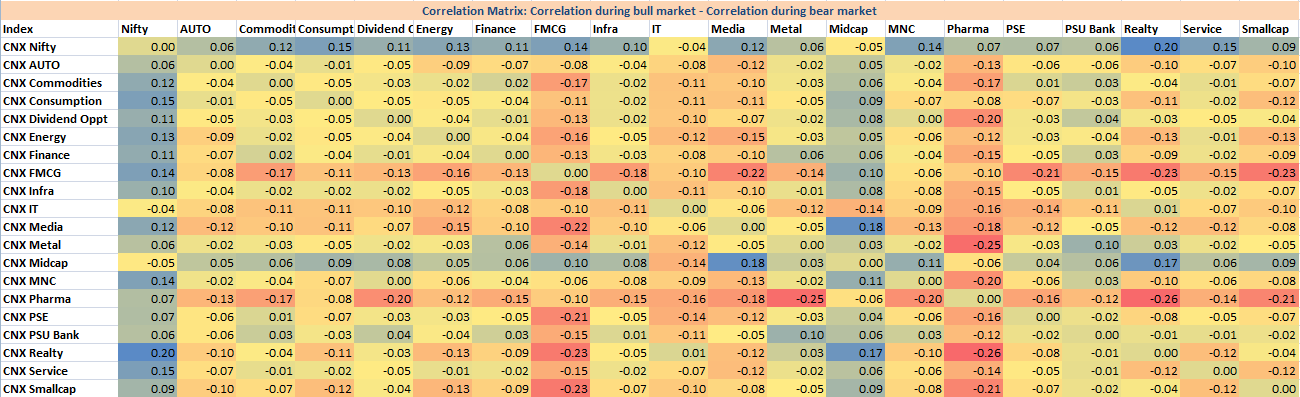
And finally, lastly but not the least, Correlation during bull market – Correlation during bear market

Image

While I was working on ways to present the data I had compiled, the above presentation was based on a article I found on bespokeinvest 


Volatility, Nifty and analyzing your system

Trading strategies are like seasons. When the season is in full swing, the person who follows a strategy that correlates with it feels like a king and the guy who follows a strategy that is antithestis of the that feels like shit. Currently, its a season of Mid and Small caps. Stocks in those pockets have gained substantially, better than what the overall markets have done for themselves.

When the markets are in a range, trend followers wonder where the good old days of smooth trends on rocks went by while mean reverters seem to be like god as they sell at tops and buy at bottoms. And then the season changes and every attempt at catching the top and bottom just goes for a toss. 

I have been in recent times investigating how volatility can affect system returns and while there is no conclusion as such that I am willing to lay upon the table, I hereby present some charts which may hold a clue to what kind of markets the system does best in.

To start off, the 1st chart on the table is one where I have taken the Geometric Mean of the daily range (High – Low) and then calculated the Standard Deviation of the same period

Image

Its no surprise to see 2000, 2008 and 2009 being the top years in terms of both range and deviation from the mean. After all, we saw maximum volatility during these years. What is interesting for me is 2012 wherein Nifty gained 27% while Nifty saw the least amount of moves on a intra-day scale. 

The Weekly Range 

Image

and the Monthly Range

Image

do not show any major difference compared to the daily range (other than percentage change). The way to use the above dataset will be to see if there is any marked difference in system returns in years of high volatility vs. years where volatility was low. Depending upon the average holding period for the system, one can compare and contrast with one of the above charts to try and see what kind of markets appeal to the system and what doesn’t.

The reason to compare in my opinion would be to figure out whether bad periods in the past (system) were due to some factor that can be in hindsight seen as a problem area for the system (you may actually have to break-down the above chart on monthly scale since its unlike systems to under-perform for years unless the logic itself is hugely faulty.

For example, check this Equity Plot (Plot starts in Jan 2012 and is upto 15/04/2014)

Image

The system had a excellent run in the initial few months (Jan – Feb 2012 being a runaway bull market) and then more or less settled down until it had one fiery run (this taking place from late July 2013 to Early October 2013). In this period, it was not a run-away market, but one where you could see huge swings (Wide Range Bars being many in the months of August and September). The system seemed to be able to take advantage of the volatility. But once the volatility ended, even though markets have climbed steadily higher from that point onwards, the system has returned zero returns indicating that the system got caught with low volatile periods and lost money (more or less – Since October 15, Nifty is up by around 800 points while the system in the same time has actually lost around 400 points) . 

Good systems (which have sustained profitable periods) are tough if not impossible to create. Markets being dynamic, no matter what one does, markets always seem to be able to get the better of us. Its hence important that one constantly revises his views and strategies while at the same time keeping in mind the fact that even the best systems can have a long period of draw-down due to unfavorable market conditions. As they say, do not throw the baby with the bathwater.


Throwing Spaghetti Against The Wall

This post has been driven by a deep discussion I had with Nooresh Merani today and hence the credit for the idea would remain with him 🙂

While study after study has shown that retail investors are unable to match the performance of the Index let alone beat it, it has not stopped a army of advisors and technocrats from coming up with new ideas, ways and thoughts on how to select stocks and become retire rich. 

There is a very famous quote by legendary trader Jesse Livermore which goes as such 

“It never was my thinking that made the big money for me. It always was my sitting. Got that? My sitting tight!”

Sitting tight is the easy thing to do when you have no real money at risk, but once you have put money, can we sit tight and hope while the stocks we have bought are moving all around. I am jumping the first step, so let me go back.

How do we create a portfolio?

A portfolio is a set of stocks we buy that we hope shall perform in the long run. But since we are provided both a price and a opportunity to trade the stocks day in and day out, its just a matter of time before we let go all the wonderful stocks we had picked (by way of Luck or Skill) while adding or at the least holding onto stocks that are touching the nadir. 

The discussion I had with Nooresh was about whether a Random portfolio (contructed purely out of chance) can beat Index returns if one just invested and sat tight. 

While we hope that every stock we buy ends up being a multi-bagger in the long run, its very rare for us to not just buy a few stocks that eventually end as multi baggers but actually hold them.

The test I did was simple. I took a 10 year time frame (long enough I presume for a long term investor). I used April 1, 2004 as the starting date. The date had the additional advantage of markets being near a short term top (in hind-sight) since after NDA lost the elections, markets took a steep dive and hence for at the very least 6 months from entry, we were underwater.

The biggest problem in conducting these types of tests is that finding historical data is tough since delisted / merged stocks are moved trimming the database of that day considerably. Since I maintain a database where delisted stocks aren’t deleted, it made it a bit easy for me to work on the approach I had decided upon.

I took the Bhavcopy of NSE of 1st April 2004. On that day, 750 stocks were traded and I removed 250 using the filter of removing any stock that had closed below 25 on the previous day (Idea is to remove penny stocks).

I then used Random function in Excel to randomize the 500 that remained. I then selected 3 sets of 25 stocks each from them (1 set each before refreshing and randomizing the set of names again – and hence a couple of stocks do repeat).

I then used the Opening prices of these stocks as per my database (where its adjusted for Bonus / Splits but not for Dividends) so as to get the current average price of acquisition. All acquisitions were assumed to be equally weighted (same money invested in each stock)

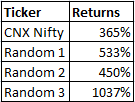
So, how did the three perform compared to Nifty. Well, here you go

Image

Every Random Portfolio beat the CNX Nifty. Is it Luck? Maybe to an extent, but what drives a diversified portfolio is if you can get caught with a few multibaggers. Regarless of how badly a few others do, since the exposure to each stock is 4%, not much of damage can happen while the ones that click big shall make more than what they lost (worse case, you lose 100% in a stock. If one stock moves 400%, it makes up for the loss of 3 of them).

I am not suggesting that you need to buy stocks randomly, buying good stocks is said to make a lot of money, but unfortunately we come to know of good stocks only after they have bolted off the stable (hindsight).

Food for thought?

File if you need to download (Link)


Nifty Percent Return as of 11th April from 2000 to 2014

Nifty Percent Return as of 11th April from 2000 to 2014

A simple return chart measuring how Nifty has performed since January 1 of the year to 11th April.