Notice: Function _load_textdomain_just_in_time was called incorrectly. Translation loading for the nimble-builder domain was triggered too early. This is usually an indicator for some code in the plugin or theme running too early. Translations should be loaded at the init action or later. Please see Debugging in WordPress for more information. (This message was added in version 6.7.0.) in /home1/portfol1/public_html/wp/wp-includes/functions.php on line 6131

Notice: Function _load_textdomain_just_in_time was called incorrectly. Translation loading for the restrict-user-access domain was triggered too early. This is usually an indicator for some code in the plugin or theme running too early. Translations should be loaded at the init action or later. Please see Debugging in WordPress for more information. (This message was added in version 6.7.0.) in /home1/portfol1/public_html/wp/wp-includes/functions.php on line 6131

Deprecated: preg_split(): Passing null to parameter #3 ($limit) of type int is deprecated in /home1/portfol1/public_html/wp/wp-content/plugins/add-meta-tags/metadata/amt_basic.php on line 118
Prashanth Krish | Portfolio Yoga - Part 62
Deprecated: Function WP_Dependencies->add_data() was called with an argument that is deprecated since version 6.9.0! IE conditional comments are ignored by all supported browsers. in /home1/portfol1/public_html/wp/wp-includes/functions.php on line 6131

Deprecated: Function WP_Dependencies->add_data() was called with an argument that is deprecated since version 6.9.0! IE conditional comments are ignored by all supported browsers. in /home1/portfol1/public_html/wp/wp-includes/functions.php on line 6131

Impact of Social Media on Investing

The arrival of Social Media (Groups / Forums / Twitter / FB / Whatsapp among others) have proved to be a boon to the ordinary investor / trader. The impact it has on my own career is pretty significant and something that I cherish especially since I started my career before the advent (in the way it is today) of Internet.

Back in those days, information was scratchy and the only people one interacted with were those who you knew personally. And unless you were in Mumbai or a major city where investing in the markets were not looked into as a crime (comparable to any other gambling avenues), the percentage of people who knew much was rather limited (personal experience) and you had to be really lucky to be able to have them as friends.

Internet has changed those things quite a bit. Now, you can talk, question and discuss the pro’s and con’s of any company that seems to catch your fancy. Crowd-sourcing is the new mantra with one needing to just start to get others to put up their views as to what is right and what is wrong about a particular investment or strategy. In other words, one can get a peer review done literally for free and all that without having to move an inch from the computer

While the advantages of using such crowd-sourced networks for information is pretty useful, the fact also remains that its not honey and ghee all the way. The ability of such discussions to cloud our judgement is pretty huge.

Take for example the fact that most investors under-perform the indices on the long run (academic research, mostly done in US). But spend a little time and you can barely see many anything lesser than what the best fund manager has done in his best year. And most are then humble enough to point out that they are just a small – part time investor / trader.

The above scenario is true regardless of whether the writer is using his real name or writing using a Anon ID (not that either makes much difference since unless the guy really wants to meet, even with a real name, he can be as much Anon as a ID which hides the name as well). What really pisses me off is the ability of these guys to influence those who are easily swayed by opinions of others. While they themselves are barely invested (using say % of networth invested), they cause disproportionate damage to the psychology of smaller investors who are generally more scared of the markets. Of course, Darwin theory holds good here, the strongest survive while the weak shall get annihilated.

Way back in the 2000, when the IT bull run was in full fury, we had a client – a Chartered Accountant no less who was investing through our brokerage firm for quite some time. He had over time accumulated a good portfolio of stocks, most of them either in cyclic business or the general Hindustan lever / Ponds India / Broke Bond kind of MNC shares.

For much of the bull run, he was able to keep his head light on how stocks outside his portfolio (specifically IT stocks) were going like there was no tomorrow. While I do not remember the conversations I used to have with this gentleman with much clarity (its been 14 long years now), I do know that some where down the line, pressure of seeing other investors doing much better than him (heck, we had a client who could not sign his own name make a bundle in a stock called Octagon Technologies) finally broke him down. So, one fine day, he decided to swap much of his portfolio as well as invest fresh funds into a portfolio of IT stocks. While he did not enter right at the peak, he entered too close to make anything on the upside (even temporary happiness) and when the blade finally came down, his portfolio was just shattered.

While I am no longer in the brokerage business to observe things as closely as I could way back then, I do wonder how much of the crowd-sourced information can lead to investors getting out of good shares and investing into small cap stocks that are going up each day more than what many a big share does in a good month.

The FOMO risk (Fear of Missing out) has a much bigger impact on us than we consider. If everyone around you is claiming to have won in a casino and while you having the knowledge that the house always wins have so far kept afar from getting into that trap, its just a matter of time before you finally decide to take a dive. This is how most Multi Level Marketing works too and best of all when every one finds out they were suckers, they always have their friends to comfort them with stories of their own losses and that some how makes one’s losses more tolerable.

Truth be told, a lot of investors do not have the skill set to Analyse the markets and for them, the best way to participate would be via ETF’s and Mutual Funds. But even those who have some skill set, do remember that markets and life itself being cyclic, it will and never shall be a case of one strategy being the winner all the time.

A lot of investors remind me of Abhimanyu (MahaBharat). They some how know how to get in, getting out is something they sincerely think will happen as easily. If only life was so easy.

If you want to be in this field, do remember that you will need a Edge to survive, a domain expertise of some kind that enables you to distinguish between the good and the bad, the ability to know when is the time to risk more and when is the time to close out the cards. Because unless you know something, you are a sheep that is slaughtered at the end of the line. As much as following some one else’s advise may get you through for some time, when the time is up, the guy who you followed will have escaped while you will be left wondering what the hell hit you.

Winners Curse – Bharti Shipyard

Investopedia definition => A tendency for the winning bid in an auction to exceed the intrinsic value of the item purchased.

While the US sees a lot of hostile take-overs, we barely see one every few years. The last one that made big news was the take over of Great Offshore. ABG Shipyard and Bharti Shiyard were involved in a prolonged battle before Bharti Shipyard won the battle. But as the relative comparison of returns by the two stocks from day of end of battle indicates, its ABG Shipyard that actually won the War.

Since Indian laws do not require 100% of the equity to be tendered or to be accepted, those who remained with the GT Offshore seem to have done even worse.

Win

Breakout Trading and Anchoring Bias

Just today, a good friend of mine was commenting on how a lot of stocks had moved strongly higher in recent days and maybe it was not advisable to buy at current prices but instead wait for a correction before entry.

The rationale offered by my friend fits the “Anchoring Bias” perfectly. We anchor ourselves to prices that we have seen in the past and instead of analysing whether a trade is still worth at the current juncture, we tend to generally hope that we shall buy it when it comes down to a price where we supposedly missed it.

A lot of stocks come to one’s attention only after they have made some thing spectacular to merit a mention. So, the day, a stock moves above its 52 Week high is one time where in we see the stock suddenly gathering the limelight. So, instead of buying that breakout, we repent the fact that we missed the stock when it was cheaper earlier.

Let me give you a example (thanks to my 20/20 Hindsight Bias). This stock was trading between 30 and 45 for long and suddenly broke off and multiplied 5x times.

1

As can be seen on the chart above (Click on it to expand to full size), the stock saw a parabolic rise once it crossed 80 bucks. The question I would like to ask is, what would been your confidence in buying this stock at this juncture (for the moment lets assume this is a company that seems to be turning around the corner as far as fundamentals are concerned).

2

Chart of the same stock as it traded in a large band over the next few months. If you had bought, would you have held it on? If you had not bought earlier, would you be more inclined now?

3

Same question as above. Even more time spent while stock seems to have taken a break and actually declined. Would you have given up?

4

A Break-out and a failure of the same. What would you be thinking now?

5

Another breakout. Should we Buy now or wait for a re-test of the breakout?

6

The stock chart as it looks now 🙂

The thing with break-out trading is that after every failure, our next entry is higher than our earlier entry and unless you take the system as it is as opposed to using our grey cells, we shall miss out on the biggies while we get caught with endless breakout failures and finally decide that maybe breakouts aren’t the best way to trade after all.

Sensex by Day of the Year

This idea comes from Eddy Elfenbein of Crossing Wall Street fame. He has done a similar analysis on the Dow and I wanted to see what outcome would I find if I apply the same concept to the Sensex (owing to it having a much later history than CNX Nifty).

The Chart below outlines the fact that Sensex has been found range-bound from mid October to early December before we follow the Santaclaus rally that is seen in the US.

Do note since I have averaged around 34 years of data, this has not much of predictive power, but at the same time gives us a visual of how Sensex has moved over the years.

The period from mid March to early October seems to be the time when the markets have been the strongest and trending strongly.

So, without much further ado, here is the Chart 🙂

Sensex

[Click on the chart to enlarge]

Postscript: Data used for the Chart above starts from 01-01-1981 and ends at 28-08-2014

Wars & Market Behavior

As Iraq boils over and America once again gets ready to intervene (albeit for now with only Air Assaults), markets seem panicky. But if history is anything to go by, Wars represent a opportunity rather than a threat for the prepared investor.

While we have had thousands of wars over hundreds of years, I have picked the most well known among them for the sake of simplicity as well as the fact that the damage these did (human and otherwise) was the biggest we have ever seen.

I have for now excluded wars where India was a participant (against Pakistan / China) since with the economy being closed and we not really having a stock Index, data (RBI Index data) is not exactly a reliable source of information as to what really happened.

First off, the following chart represents the time line of World War I

WW-I

While US markets dived in the very month major hostilities started, the fact that markets also closed for few months would have had a impact on the behavior as well and hence one would need to look at it from the perceptive of how markets traded once it restarted in Jan of 1915. Dow not only recovered all the losses in the coming months but actually made a multi-year high.

Here is the chart representing the period of World War II

World War II

A bit different from what happened in World War I with markets actually slowing moving down as hostilities in Europe opened up (do note that US did not officially enter the War until the bombing at Pearl Harbor). But by the time America entered, markets had already bounced of the bottom and once the war ended, we saw a multi decade bull market with the levels being seen during World War II never being seen again (more due to change of world order which was purely due to the War).

While the next major war was the Korean war which resulted in the division of Korea, the actual time of war was pretty short in comparison to previous wars discussed above and the markets (Dow Jones) seems to have not even bothered about it as it went about its business.

One of the highest military and civilian causalities the world saw after World War II was the Vietnam War. Markets though once again went on with the business as usual approach and major dips were a occasion to buy than panic and sell as the charts clearly shows us (of course, in hindsight with perfect knowledge, its all very easy now 🙂 )

Vietnam War

The Invasion of Kuwait by Iraq resulted in the first Gulf War and in a way what we see today in Iraq is a indirect result of that decision by Saddam Hussein. In the last 25 years, while much of the world has improved by leaps and bounds, Iraq has gone so back that it will take years just for it to get back to where it stood in 1990 (even accounting for the devastation they saw during the Iran-Iraq war).

While Dow did fall in the intial stages of the war especially as Crude Oil spiked and rekindled fears of the Oil Spike the world saw in 1973, once those fears got removed, markets rebounded strongly and on the charts, appears as a mere blip in the long bull rally Dow saw between 1987 to 2000.

I

If there was any hope for Iraq to become a normal country again, the Second Gulf War more or less buried any hope. Markets though loved this war too and in a way can be seen as the first major rise in the 2003-2008 bull rally.

As panic once again strikes the market, I am reminded of this best selling book “This Time is Different” by Carmen M. Reinhart and Kenneth Rogoff. Market behaviour does not change and there is no doubt that the end result will we way different than the prophetic sayings one sees during this time.

I believe one needs to wait for the right opportunities to present themselves and when they do, make the max of it. For no matter what happens, the world will not end because of one war or one sanction (Russian Sanctions being more of a joke especially as they are dependent on Imported items that they have just banned more).

The saying “One man’s misfortune is another man’s gain” is something that is apt for the current time and circumstances.

Nifty Update – time for a correction?

Its been quite some time since I wrote my view on Nifty, not that anyone would care if I wrote or not, but then again, writing a blog post is the easiest way to record one’s thought at that particular point of time.

We saw the first major move in Nifty in October of 2013 when it moved the closest to the all time high on Nifty since 2010. But it took another couple of months for a new high to be set and while we did set a new all time high in December, there was no follow up action and the Index gave back much of the gains over the next couple of months.

A clear cut break-out though was witnessed in March and the Index has not looked back ever since. While the trend remains unequivocally bullish, we need to question as to whether the markets are finding the path of least resistance on the down-side against the expected continuation of the trend on the upside.

8000 is the level that most Investors and Traders seemed to be focused on. But like a magician, markets have this unique ability to spring out a surprise that is least expected and one needs to be wary of the same.

A bull market is seen as having started after the markets breach the previous all time highs and in that affect, we are at the start of a bull market since the breach of 6350 is just 4 months old. But then again, if one goes back to the 2000 bull rally, we saw the break of the 1994 high in December 1999 and were re-testing and breaching the break-out point as early as April 2000.

While hindsight informs us that the rise and fall was all due to the euphoria we saw in IT stocks (Indian markets did not have Dot com companies listed in the way Nasdaq had), at the point of time, many a investor and trader were left wondering what was happening as they saw their portfolio haemorrhage as stocks fell across the board.

Of course, things are not as bad as they were in 2000 or in 2008 (start of the year), but we have seen stronger reactions in markets without they having to reach the exuberance stage – Example: In November 2010, markets topped out at 6338 and found its final bottom only in December of 2011 at 4531, a correction of 28%, not something to ignore.

So, without any further ado, let me present charts which seem to suggest that it may pay to be careful and not get caught with the excitement shown by market participants and TV / Twitter pundits.

My first chart is of the Nifty PE with Average and Standard Deviation plotted. Do note that the PE is from Standalone results of the trailing four quarters and if one were to use Consolidated results, the current PE may seem to be lower than what this graphic shows.

Nifty

The PE chart above shows that while markets are nowhere close to where they were in 2008 or 2004 or the recent 2010, we are at a point which is pretty close to the 1 Standard Deviation (last time we were at a similar PE level was in June 2011 when Nifty was trading at 5650. Shows how much of a improvement we have seen in the earnings).

While the positive fact as outlined above is that we aren’t by any stretch overly expensive, we are beginning to get there though there is still ample time before we see similar levels (assuming no change in earnings, Nifty needs to move by 36% from the current level to match that of Nifty 2008 exuberance).

On the negative side, the fact that we are the most expensive among BRIC and Emerging nations (most, measured via CAPE) does mean that we need to see how fund flow will behave in the coming weeks / months. With big IPO’s lined up, chances of they sucking out the liquidity from markets remain high too.

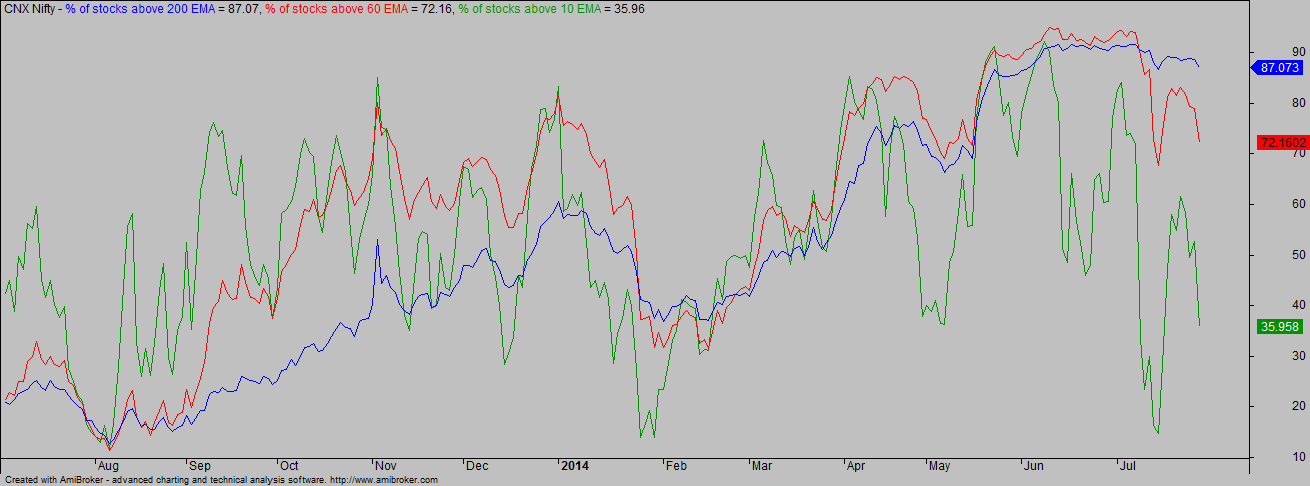
When markets start of top out, the first signs are visible in the broader markets which fail to match the big boys and start to show signs of decline. In the following chart, I have lined up a composite of stocks trading above their 200 day EMA, their 60 day EMA and their 10 day EMA.

Nifty

There is not much of a damage in terms of stocks above 200 day EMA. But then again, that is to be expected since we are yet to see even 1 week of decline and markets have made their new high today too.

The 60 day (representing approximately 3 months) seems to showcase some damage as it not only was unable to make a new high when markets rallied in this week but its trending down too.

The 10 day (representing approximately 2 weeks) shows the maximum damage as it moves lower. Do note that on 14th of this month, when Nifty made its recent pivot low, the percentage of stocks above their 10 day EMA was as low as was seen in February of this year (just before the markets took off).

This kind of divergence happens all the time, but since we are seeing it happen even as markets have made a new high makes it more worthy of noting.

The next chart showcases the number of days since we saw Nifty testing its 50 day EMA. In the great bull run of 2003-2008, the maximum number of days which Nifty was above the 50 day EMA was 130 days (in 2006). Currently that number is 105 but more worthy a point to note is that the 50 day EMA itself lies 7481 and it would take a reaction of 300 odd points (or passage of time wherein the EMA will creep higher without a requirement there being any major fall in the intervening period).

Nifty

Major cracks in markets happen when exuberance is high and unfortunately we don’t seem to have any data in that regard. The US markets which too have been on a strong upward trajectory has its AAII Bullish and Bearish sentiments are nowhere their high / low points.

Technically, today, we broke back below the recent high making a small double top in the process. But whether its a valid signal (due to the low amount of time spent between those two tops) make is uncertain as to whether we have topped out for the medium term (long term trajectory is very much up and I doubt it changing anytime soon).

Bank Nifty has been one of the laggers in the current rally and the way it moves may dictate the future of Nifty as well. If Bank Nifty breaks and closes above 15750, we are back on the bullish bandwagon, but if it instead breaks 14300, it would be good bye to bulls, at least for a few months if not more.

Trading vs Buy & Hold on Nifty

For a long time now, I have been advocating that any strategy that does not beat Buy & Hold returns is not worth following. The basic reasoning behind the said thought is the fact that Buy & Hold is the easiest way to earn money in markets and unless additional returns can be generated by trying to time the market, it makes very little sense to do anything at all and instead spend the time and effort in a venture of our choice.

But on the other had, the advantage of using a systematic strategy is that the probability of your draw-down being lower than the market is pretty high. While deep cuts do not happen at regular intervals, when they do such as in 2008, its always better to be out of the market (or better short the market) than twiddle the thumbs and hope that the markets start to react back to higher ranges.

Lets for sake of example, take a simple Moving Average Crossover – EMA of 3 crossing EMA of 5. The reason I have chosen this particular multiple is due to the huge amount of discussions that have happened previously as well as the fact that this is one of the best cross-overs among the many others than I have tested. But the fact does remain that this strategy (MA Cross is known for a very long time though much work in my circles has been done by Vish)

If I were to test the same with zero commissions and zero slippage (on Nifty Rolling Month futures from Start of Series in 2000 till date), we see that the strategy would have given us a profit of 7272 points in Nifty vs. a Buy and Hold (and ignoring for Dividends) which would have given us 6018 points in the same time span.

Since futures positions are generally created using leverage, this is not exactly a apples to apple comparison. But before we do that, lets include some transaction and slippage charges so as to make the results more realistic.

Those of whom have been trading for long would remember that its only in recent times that we have brokerage the kind Zerodha offers. I still remember paying 0.05% brokerage even in 2003 / 04. While brokerage has reduced, we now have STT to partially offset the gains from lower brokerages. Slippages too have reduced over time.

Since the back-test is being on a extremely long period of time, I would hence use a 3 times leverage with transaction charges kept at 0.03%. Now, lets look at the results once again.

The gains that we now have is close to 18750 points which comes to a bit higher than 3x of Buy & Hold. 3x of No Transaction charges would have given us 21816 points. The difference is what the cost of the transaction would equal to (on an approximate basis).

But this is not the end result either. You see, while a Buy & Hold investor has the advantage of not paying any tax on the gains (Long term gains being Zero), the same is not true for we, the short term derivative traders. The income so gained is seen as Business Income and charged under the slap which the investor comes into.

For sake of argument, lets assume that we fall under the highest slab and hence lets charge 33% of gains as tax payable. That would reduce our gains to 12562 points. Way less than what we initially started off with but still a little more than double what we could have made from a pure Buy & Hold strategy.

And what about the risk you may ask. Well, the risk (if you measure it through say Draw-down) is actually lower than Buy & Hold. While Buy & Hold would have seen you bear a max system draw-down of 60% (in Oct 2008), in the system you would have seen a max draw-down of just 18.5%, a number which is much more tolerable.

And best of all, I have not compounded my positions through the 14 year test. Even if one used a basic position sizing algorithm, I can assure you that the end result would be way higher than what has been showcased here.

Of course, what is life without some hitches along the way. While you have been a happy man in 2008 reaping your best profits even as the rest of the market was seeing blood on the streets, you would not be so happy as on date what with your strategy under-performing the markets since December of 2012 (current draw-down being 6.51% even as Nifty has moved by 1500 points in the interim).

The above trend following strategy is just a simple example to showcase how one can beat the markets even after accounting for all costs that are not accrued by a Buy & Hold investor. But that said, it also requires tremendous discipline since trend-following strategies generally tend to under-perform strong bull markets (this above strategy for example did not make a cent in the whole of 2007).

While Technical Analysis as seen on Television has been reduced to some sort of astrology, the fact remains that the true aim of technical analysis is to have the ability to reduce the risk. Once the risk of failure is controlled, its always easy to find a way to make more than what any other strategy can provide for.

Do note that I have not taken roll-over costs into account in the example above since I believe that the probability is high that over such a long period of time, roll-over costs shall cancel each other out (since we also take and rollover Short positions). But that maybe something to test some other time 🙂